 Minh Hai Nguyen
Publications & talks
Also on Google Scholar.
Publications
2026
-
ICMLICML Proceedings of the 43rd International Conference on Machine Learning (ICML), 2026
Supervised convolutional neural networks (CNNs) are widely used to solve imaging inverse problems, achieving state-of-the-art performance in numerous applications. However, despite their empirical success, these methods are poorly understood from a theoretical perspective and often treated as black boxes. To bridge this gap, we analyze trained neural networks through the lens of the Minimum Mean Square Error (MMSE) estimator, incorporating functional constraints that capture two fundamental inductive biases of CNNs: translation equivariance and locality via finite receptive fields. Under the empirical training distribution, we derive an analytic, interpretable, and tractable formula for this constrained variant, termed Local-Equivariant MMSE (LE-MMSE). Through extensive numerical experiments across various inverse problems (denoising, inpainting, deconvolution), datasets (FFHQ, CIFAR-10, FashionMNIST), and architectures (U-Net, ResNet, PatchMLP), we demonstrate that our theory matches the neural networks outputs (PSNR ≳ 25 dB). Furthermore, we provide insights into the differences between physics-aware and physics-agnostic estimators, the impact of high-density regions in the training (patch) distribution, and the influence of other factors (dataset size, patch size, etc).
@inproceedings{nguyen2026analytictheoryconvolutionalneural,
  title = {An analytic theory of convolutional neural network inverse problems solvers},
  author = {Nguyen, Minh Hai and Do, Quoc Bao and Pauwels, Edouard and Weiss, Pierre},
  booktitle = {Proceedings of the 43rd International Conference on Machine Learning (ICML)},
  year = {2026},
  eprint = {2601.10334},
  archiveprefix = {arXiv},
  primaryclass = {cs.CV},
  url = {https://arxiv.org/abs/2601.10334},
}
2025
-
 SIIMS SIAM Journal on Imaging Sciences (accepted), 2025
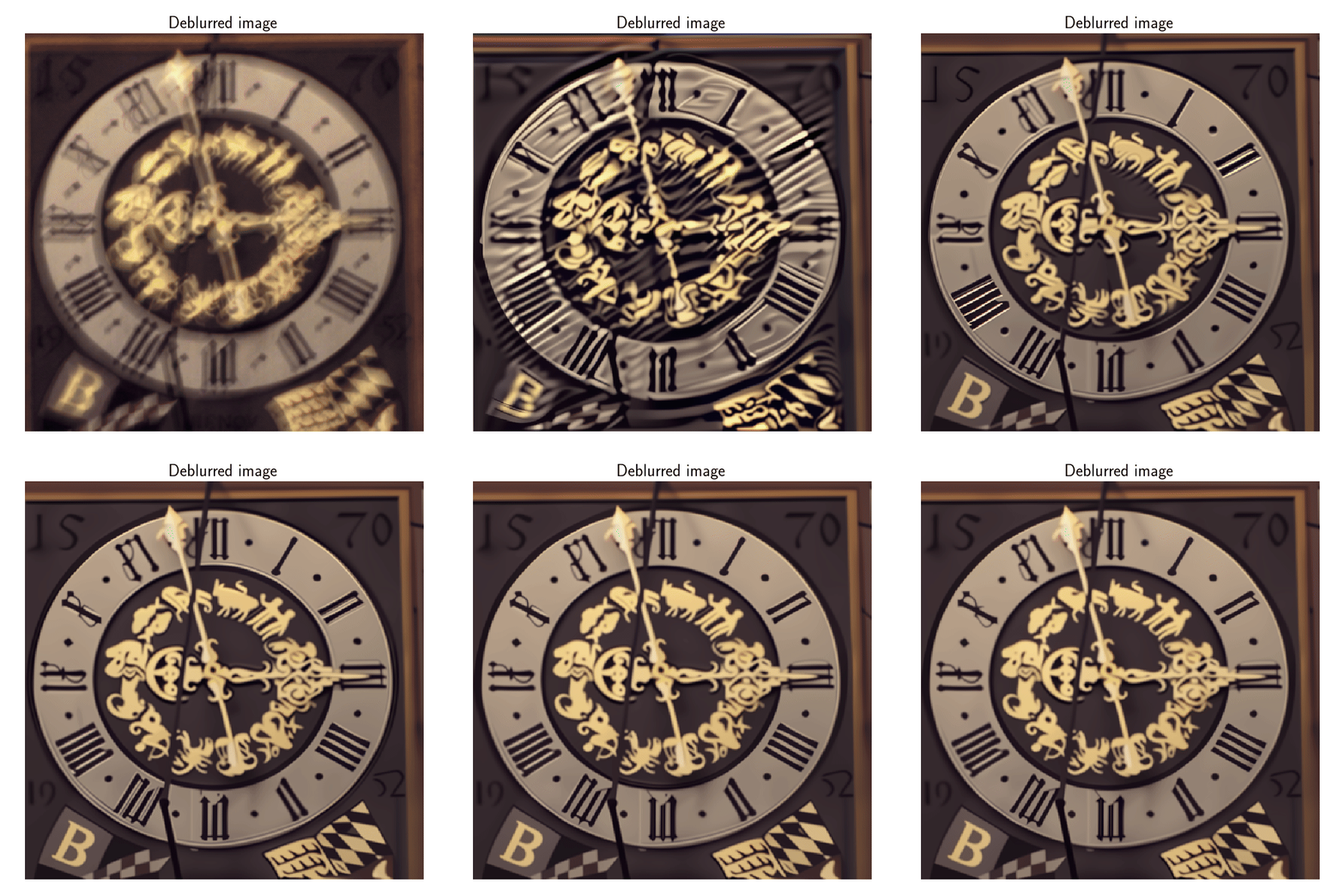
Maximum A Posteriori (MAP) estimation is a cornerstone framework for blind inverse problems, where an image and a forward operator are jointly estimated as the maximizers of a posterior distribution. In applications such as blind deblurring, this principle is used to recover sharp images from degraded observations. In this paper, we analyze the recovery guarantees of MAP-based methods by adopting a Morse–Bott framework. We model the image potential as a Morse–Bott function, where natural images are modeled as residing locally on a critical submanifold. This means that while the potential is locally flat along the “natural” directions of the image manifold, it is strictly convex in the directions normal to it. We demonstrate that this Morse–Bott hypothesis aligns with the structural properties of state-of-the-art learned priors, a finding we validate through an experimental analysis of the potential landscape and its Hessian spectrum. Our theoretical results show that, in a neighborhood of the ground-truth image and operator, the posterior admits local minimizers that are stable both with respect to initialization (gradient descents converge to the same minimizer) and to small perturbations of the data (solutions vary smoothly with the observations). This local stability potentially provides a theoretical justification for the empirical success of well designed gradient-based optimization in these settings. However, we also demonstrate that this local stability is a local property: the “blurry trap”, well-known for sparse priors in blind deconvolution, persists even with state-of-the-art learned priors. Our findings demonstrate that the failure of MAP in blind deconvolution is not a limitation of prior quality, but an intrinsic characteristic of the landscape. We conclude that successful recovery depends on strategic initialization around favorable local minima. We describe an heuristic strategy which is validated with numerical experiments on both synthetic and real-world data. The code for reproducing the numerical experiments in this paper is available at https://github.com/mh-nguyen712/blind_deblur_diffusion
@article{nguyen2025diffusionpriorlandscapesshape, title = {A Morse-Bott Framework for Blind Inverse Problems: Local Recovery Guarantees and the Failure of the MAP}, journal = {SIAM Journal on Imaging Sciences (accepted)}, author = {Nguyen, Minh-Hai and Pauwels, Edouard and Weiss, Pierre}, year = {2025}, eprint = {2508.02923}, archiveprefix = {arXiv}, primaryclass = {cs.CV}, url = {https://arxiv.org/abs/2508.02923}, } -
 arXiv arXiv preprint, 2025
DeepInverse is an open-source PyTorch-based library for solving imaging inverse problems. The library covers all crucial steps in image reconstruction from the efficient implementation of forward operators (e.g., optics, MRI, tomography), to the definition and resolution of variational problems and the design and training of advanced neural network architectures. In this paper, we describe the main functionality of the library and discuss the main design choices.
@misc{tachella2025deepinversepythonpackagesolving,
  title = {DeepInverse: A Python package for solving imaging inverse problems with deep learning},
  author = {Tachella, Julián and Terris, Matthieu and Hurault, Samuel and Wang, Andrew and Chen, Dongdong and Nguyen, Minh-Hai and Song, Maxime and Davies, Thomas and Davy, Leo and Dong, Jonathan and Escande, Paul and Hertrich, Johannes and Hu, Zhiyuan and Liaudat, Tobías I. and Laurent, Nils and Levac, Brett and Massias, Mathurin and Moreau, Thomas and Modrzyk, Thibaut and Monroy, Brayan and Neumayer, Sebastian and Scanvic, Jérémy and Sarron, Florian and Sechaud, Victor and Schramm, Georg and Vo, Romain and Weiss, Pierre},
  year = {2025},
  eprint = {2505.20160},
  archiveprefix = {arXiv},
  primaryclass = {eess.IV},
}
2024
-
 IEEE TGRS IEEE Transactions on Geoscience and Remote Sensing, 2024
In this paper, we propose new algorithms for estimating micro-vibrations and correcting its effects in satellite imaging with linear pushbroom camera. We first design an accurate model of the acquisition process with linear pushbroom camera, that incorporates the satellite attitude as parameters. We then propose a two stage reconstruction method based on an identification neural network to identify the attitude, followed by a deep unrolled network to correct the micro-vibrations. We then evalu- ate the proposed framework on synthetic and real data, showing promising results for this challenging problem. Our results highlight the critical role of the focal plane’s geometry, to improve the micro-vibrations identifiability and therefore, the reconstruction quality.
@article{10559627, author = {Nguyen, Minh Hai and de Vieilleville, François and Weiss, Pierre}, journal = {IEEE Transactions on Geoscience and Remote Sensing}, title = {DeepVibes: Correcting Micro-vibrations in Satellite Imaging With Pushbroom Cameras}, year = {2024}, volume = {62}, number = {}, pages = {1-9}, keywords = {Cameras;Satellites;Noise;Vibrations;Orbits;Mathematical models;Charge coupled devices;Convolutional neural network (CNN);jitter;microvibration;pushbroom;satellite imaging;unrolled network}, doi = {10.1109/TGRS.2024.3415372}, } -
preprintpreprint preprint, 2024
Plug-and-play and unrolled methods are among the most popular and efficient approaches for solving inverse problems in imaging. In this paper, we review their similarities and differences. We adopt a Bayesian framework to explain their statistical properties. This allows us to relate plug-and-play methods to Maximum A Posteriori (MAP) estimators and unrolled networks to Minimum Mean Square Error (MMSE) estimators. We clarify some of their properties including their stability and numerical efficiency. Overall, this paper provides a concise review of their respective advantages and limitations.
@article{nguyen2024pnp-unrolled,
  title = {Comparing Plug-and-Play and Unrolled networks},
  author = {Nguyen, Minh Hai and Weiss, Pierre},
  year = {2024},
  journal = {preprint},
}
Talks & posters
-
Talk From analytic CNN surrogates to recovery guarantees for learned inverse-problem solvers
-
Talk From analytic CNN surrogates to recovery guarantees for learned inverse-problem solvers
-
Talk An analytic theory of convolutional neural network inverse problems solvers
-
Talk DeepInverse and Computational Imaging
-
Talk How diffusion prior landscapes shape the posterior in blind deconvolution
-
Talk How diffusion prior landscapes shape the posterior in blind deconvolution
-
Talk Blind deconvolution in optical microscopy
-
Poster Deep learning-based blind deblurring in microscopy
-
Talk DeepVibes: Correcting micro-vibrations in satellite imaging with pushbroom cameras